
The company culture conversation isn’t anything new, but as employment rates stay low and the remote versus in-office debate volleys back and forth, it’s a discussion here to stay.

Intentionality is at the core of building company culture; sometimes, the strongest advocates for culture come from inside the building. Often, the best response leadership can give its employees is to listen and empower employees to suggest and implement plans. This approach isn’t just about the warm fuzzies; Gallup reports an eighty-five percent net profit increase over five years within companies that build a strong culture.

So, what does this look like in a real-time, tangible way? With offices and time zones spread across the country, The Alexander Group, like many other professional services firms, asked the same question, with leadership actively listening and welcoming ideas.

The results?

Well, for one, you will find most of us gathered or in front of our computers the third Thursday of every month for happy hour, a 60-minute opportunity to chat, laugh and discover new things about each other. The Alexander Group’s Anthony Ott spearheads the monthly event, drawing from experiences at a former employer.

“We have our heads down, working so hard that it’s nice to take a breath and get to know each other better,” associate Anthony Ott said. “We talk about non-work things and that helps build camaraderie, empowerment and trust.”
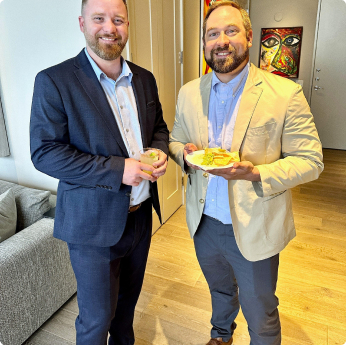
Ott uses an app that randomly selects the various groups each month, making sure at least one member of leadership is included, supplying the teams with ice breakers, trivia, quizzes and other conversation starters should they be needed. The Alexander Group is a gregarious bunch, so while the trivia has largely gone untouched, the spirit behind happy hour is thriving. The four to six people per group allows for conversation in a small setting, which is also by design.

“Having a small group is more conducive to really talking with each other. It allows us to see another side of a co-worker they may not normally see because we’re in a work mindset,” Ott said. “We all have a common denominator, and this gives a chance to expand culture and team building.”

Sociologist Tracy Brower studies work-life happiness and fulfillment and calls this “Social Capital,” the ability to form fulfilling relationships, generate new ideas and ask advice for how to get things done within the organization.

“Strong cultures also have intricate webbing of social capital—the networks of people across the organization. To maintain positive cultures in hybrid/remote working situations, leaders need to be intentional about encouraging people to build their networks,” Brower said. “They can do this by connecting people across departments, providing for cross-functional learning opportunities and creating time for people to have virtual coffee or networking discussions with colleagues across the company.”

The happy hours are in addition to monthly catered lunches where staff is encouraged to catch up over a meal, group outings to play darts or Top Golf and annual company retreats. Many of The Alexander Group team members, including managing director John Lamar, are based in California, so the West Coast contingent makes it a priority to gather in person a few times a year.

“It’s so much fun to meet in person, give them a hug and spend that time together,” Ott said.

A by-product of leadership-supported gatherings is the framework of a safe space to exchange ideas and encourage mentorship. Employees who know they are seen and heard feel valued, and that means greater staff retention.

McKinsey & Company study authors Terra Allas and Brooke Weddle say connection building helps meet the psychological and emotional needs of employees. They suggest setting up regular/daily meetings at the beginning of each day, allowing time for socializing and creating regular events to build social connections. McKinsey research shows society is a key source of meaning for employees, along with company, customer, team, and individual.

Indeed, that is what Pax8 CEO John Street finds with his employees. Street prioritizes inclusivity within his company, connecting every day with someone on his staff in a meaningful way.

“Creating a feeling of belonging locally, regionally and globally is priceless, and sustaining that feeling requires an inclusive approach and active commitment from leaders. For example, I make it a practice to call one employee each day and ask, “What’s going on in your world? What are you thinking about?” These discussions help me signal to every employee that they belong and are valued,” Street said in a January 2023 Forbes Magazine article. “Embedding inclusion and belonging is a core tenet of employee recruitment and retention.”

Indeed, Ott, knowing he was heard and supported by leadership, was motivated to expand the social capital plans at The Alexander Group. Next steps include one-on-one exchanges where team members can dedicate time for business development, marketing and organizational ideas and a quarterly exchange of constructive firm-wide suggestions.
“Empowered employees feel like they have a voice. We all come from different places and have different ideas. We all have something to offer,” Ott said.

Street has also found an energized employee base by listening to his staff. They feel encouraged and see themselves rising within Street’s IT company.

“When employees know their voices are being heard, they not only feel engaged but are actually engaged. Innovations rise to the top, and the individuals who bring great ideas to the table often become future leaders in the organization. Because they deeply understand the importance of being heard, these new leaders will then continue to prioritize listening to team members. Leaders can encourage employees to speak up in a variety of ways, like physical or virtual suggestion boxes, surveys or simply asking them directly,” Street said.

Every company is different, so if happy hour and axe throwing aren’t exactly the social experiences your team would appreciate, human resources expert Renee Cocchi says what’s most important is choosing activities that will help teams get closer to each other, be happier and more comfortable in the workplace so they can produce their best work. Planning to get social? Cocchi offers these tips when adding events to the culture-building event calendar:

  • Clearly communicate the goals and purpose of the activity
  • Encourage participation and collaboration from all team members
  • Make the activity fun and enjoyable, but also challenging.
  • Follow up on the activity to discuss any lessons learned and how they can be applied in the workplace.

Several years ago, we wrote about the importance of morning routines and how successful leaders-both today and from the past-start their day. Now let’s look at the other end of the spectrum: nighttime routines.

Why is it important? Generally speaking, success starts and ends with mental and physical health which is highly dependent upon getting enough sleep. It can be tempting to pour a glass of wine, turn on the TV, and pore over social media or clear your in-box right before bed, but the most successful people recognize that those final hours can be just as crucial as any other.

While everyone is different and has different routines, we find the following practices are common among successful leaders.

1. Make a to-do list

Clearing the mind for a good night’s sleep is critical for many successful people,” Michael Kerr says. Often, they will take this time to write down a list of any unattended items to address the following day so these thoughts don’t invade their headspace during the night.

For example, Kenneth Chenault, former CEO of American Express, writes down three things he wants to accomplish the next day. Others use Sunday evenings to prep for the week ahead.

2. Disconnect from work

Studies have found that if you associate your bed with work, relaxing there will be more challenging, so you must reserve your bed for sleep and other extracurricular activities. International business speaker and author, Michael Kerr says that “truly successful people do anything but work right before bed. They don’t obsessively check their email and they try not to dwell on work-related issues.”

Give yourself a buffer period of at least half an hour between reading your last email and going to bed.

3. In fact, unplug completely

You shouldn’t just disconnect from work. You should unplug completely, including social media and phone games. Researchers agree that any kind of screen time before bed does more harm than good.

The blue light from your phone mimics the brightness of the sun, which tells your brain to stop producing melatonin, an essential hormone that regulates your circadian rhythm and tells your body when it’s time to wake and when it’s time to sleep. This could lead not only to poor sleep but also to vision problems, cancer, and depression.

If the research isn’t convincing enough, take it from Arianna Huffington, The Huffington Post’s co-founder, President, and Editor-in-chief. After collapsing from exhaustion, Huffington revamped her approach to sleep. As she details in her book, “Thrive,” she has banned iPads, Kindles, laptops, and any other electronics from the bedroom.

4. Exercise

While it’s a popular belief that exercise before bed can prevent sleep, the National Sleep Foundation actually found in a 2013 study that exercising at any time of the day, even at night, leads to better sleep. Numerous studies have also found that walking reduces stress and anxiety.

Joel Gascoigne, co-founder and CEO of Buffer, takes a 20-minute walk every evening before bed. “This is a wind-down period, and it allows me to evaluate the day’s work, think about the greater challenges, gradually stop thinking about work, and reach a state of tiredness.”

John Lamar, Managing Director, The Alexander Group, says that he usually “hits the elliptical for 30 minutes-a great way to de-stress and wind down.”

5. Decompress

If exercise doesn’t sound appealing, find another way to unwind and decompress before bed, such as taking a warm bath, listening to calming music, or meditation. Dale Kurow, a New York-based executive coach, says meditation is a great way to relax your body and quiet your mind. Apps like Headspace, Calm, and The Mindfullness App offer guided meditations and reminders to incorporate meditation into your daily routine.

6. Plan out sleep

Much has been written about the dangers busy people face with chronic sleep deficits. Plan for a good night’s sleep just as you would any other priority. Decide when you want to wake up, count back by the number of hours you need to sleep, and then plan to be in bed, ready to sleep, by that time. iPhone users: Take advantage of the “Bedtime” feature of your Clock app. It allows you to set a bedtime, wake up at the same time and stay consistent with your routine. There’s even an option to set a bedtime reminder.

7. Skip the wine

When researching her sleep manifesto, “Thrive,” Arianna Huffington consulted a number of sleep specialists for tips. One of her favorites is avoiding alcohol right before bedtime.

While alcohol can certainly help you fall asleep, the National Institute of Health finds that it robs you of quality sleep. Alcohol keeps people in the lighter stages of sleep, which they can be awakened easily, and prevents them from falling into deeper, more restorative stages of sleep, the institute finds.

8. Read

One study by the University of Sussex found that just six minutes of reading a day is enough to reduce stress by 68 percent-“an excellent excuse to start curling up with a good book before you turn in for the evening,” points out Fast Company magazine. And you’d be in good company: Former US President Barack Obama and Microsoft founder Bill Gates are known to read for at least a half hour before bed.

This isn’t reserved just for business reading or inspirational reading. Many successful people find value in information from a variety of sources, believing it helps fuel greater creativity and passion in their lives.

Sarah Mitchell, a Director in our San Francisco office, agrees: “I almost always read for 30 minutes before bed-typically fiction or, if it’s nonfiction, something unrelated to business. If I’ve got a big day or I’m feeling stressed, I will spend part of my evening preparing for the next day, and then, 30 minutes before lights out, I put down my phone, shut down the laptop, and relax my brain with a book. This helps me sleep better and gives my brain a needed timeout so I can wake up fresh in the morning.”

9. Reflect on the good things from the day

It’s easy to fall into the trap of replaying negative situations you wish you had handled differently. Instead, take time just before bed to reflect on or write down three good things that happened during the day. Focus on the positive moments and celebrate the successes, even if they are few and far between.

Jennifer Hill, Startup Advisory and Venture Lawyer at Gunderson Dettmer LLP, says she takes “two minutes to stretch, align my posture and think of the three things that I am grateful for and proud of today. (Yes, I really do this.) It sends me off to sleep peacefully and with positive thoughts.”

Benjamin Franklin famously asked himself the same self-improvement question every night: “What good have I done today?”

Regardless of how the day went, successful people avoid that pessimistic spiral of negative self-talk, knowing that it will only create more stress. Taking a few moments to think about what went right over the day can put you in a positive, grateful mood, leading to better sleep and giving you energy and clarity.