Wendela von Munching has joined Clifford Chance as Chief People Officer.
Ms. von Munching has more than 25 years of strategic and operational human resources leadership experience with major multinational firms. Previously, she served as the worldwide Chief People Officer for Freshfields.
Leadership puzzle piece symbolizing the CIO role in law firms as a crucial element.
Historically, the CIO role in law firms has required an innovative strategist with an ironclad technology background to drive success. However, as law firms and client needs continue to evolve in the wake of artificial intelligence and client needs and expectations, so does the legal CIO role.
The Evolving Responsibilities of the CIO Role in Law Firms
A 2023 survey conducted by CIO Magazine reported that 47 percent of technology executives said security management and improving IT operations and systems performance were their top two responsibilities. Tasks such as business innovation, identifying competitive differentiation opportunities and business strategy were at the low end of the to-do list.
Fast-forward two years, and CIO feedback is changing along with expectations. CIO Magazine reports that the same technology leaders see driving business innovation as a top priority.
The surveyed CIOs said increased levels of business-focused strategic responsibilities will become part of their daily agenda, with technological emphasis being handed to other tech professionals within the firm.
It’s a sentiment echoed by The Alexander Group’s coterie of managing directors and directors, who have conducted dozens of CIO searches for law firm clients over the past four decades. We know the specific needs of law firm clients seeking forward-thinking CIOs who cover the tech infrastructure and bring leadership, communication, and innovative thinking to the table.
What will the expanded role of the law firm CIO look like in 2025, 2026, and beyond? Our team weighs in on this evolving role’s position requirements and responsibilities.
Insights from The Alexander Group on Law Firm CIOs
As the CIO role in law firms expands, so does the skill set required to excel. Today’s legal CIOs are expected to be more than just tech-savvy—they are strategic leaders, collaborators, and innovators. Here, The Alexander Group’s seasoned managing directors and directors share their perspectives on the essential qualities and evolving responsibilities that today’s top law firm CIOs must bring to the table.
John Lamar, Managing Director, The Alexander Group
“Just as law firm marketing has evolved into strategic business development, so has information technology. Now, stemming from IT roots, you will find chief innovation officers, chief security/data security officers, and chief knowledge management officers roles. All of these require an understanding of technology, both firm-side and that of their clients.
That said, IT infrastructure and support are table stakes. The CIO role and these newer, evolved roles begin with understanding business and client relationships, actively collaborating with clients, and finding ways to make those client relationships sticky.”
Amanda Brady, Managing Director/Chief Client Officer, The Alexander Group
“In the past, CIOs were primarily concerned with the network and infrastructure side of technology, but that has changed considerably. Many firms now understand the applications, various databases, and ease of use by all constituents is a much more valuable set of skills.
The amount of data collected by law firms is huge, and this, coupled with cross-level cyber security and AI, means that a top-flight CIO has to have extraordinary technical skills and understand what solutions may help lawyers in the practice of law and business professionals run the operations of the firm.
The entire landscape is considerably more complex. An effective CIO must also be a strong teammate to other chiefs and an excellent manager of people who are perhaps not as blessed with good communication skills.”
Sally King, Managing Director, The Alexander Group
“The CIO role has been in the spotlight recently–from mitigating increased cyber-security threats and addressing client-driven information security requirements to shepherding and leading the migration to robust and reliable remote-work capabilities; to evaluating and deploying next-generation AI tools and pilot programs. And as a result, the level of institutional change management, business acumen, and firmwide strategic leadership skills have become equally important as technical expertise and operational know-how for top-tier CIOS.”
“Law firms are increasingly hiring new CIOs. Historically, the IT function has been a critical operational function for law firms. The increasing demands on the technology function to be a driver of the business, as opposed to a supporter of the business, has led to a need for more business-savvy, forward-looking, strategic CIOs.
The job description has evolved from infrastructure, software, and support aspects of the CIO role to a much greater emphasis on information security and technology innovation (including, but certainly not limited to, AI).
Many of our law firm clients have created separate, peer-level Chief Information Security Officer and Chief Innovation Officer roles to elevate those functions and work arm-in-arm with the more traditional CIO.”
The law firm CIO role is evolving to become a top-to-bottom position emphasizing strong internal and external communication skills and the ability to be nimble in all aspects of the role. The CIO is a vital element of firm administrative leadership and will have the opportunity to contribute to a firm’s future in ways not previously imagined or expected.
Progress and innovation lie at the heart of technology, making this time in the CIO life cycle more dynamic and challenging than ever before and setting the stage for what’s next.
Visit our website for C-suite recruitment services tailored to law firm leadership and navigating the evolving CIO role in law firms.
With 2025 just around the corner, we’re looking to the future of legal industry trends, anticipating and planning for what’s next. While we don’t have a crystal ball, we do have 40 years of executive recruiting experience, a deep well of data, and the trust of our clients, who express their leadership needs to us as they plan for 2025 and beyond.
John Lamar, Managing Director, The Alexander Group
“AI continues to dominate people’s thought process in making the firm efficient and profitable. Tech is a driving force, but it’s not where it needs to be. Everyone’s doing window dressing right now, hiring chief innovation officers, but in reality, firms are buying off-the-shelf software products. That will change in the years to come.
Another trend garnering attention concerns partners getting paid ungodly amounts of money. They are offered multi-year 25- to 30-million-dollar deals. How long can the industry sustain that?
I’m hearing a lot from chairs about work-from-home. It’s interesting in Europe; they all comment that everyone’s back 100 percent; the U.S. is the only country with three days in the office. It’ll be interesting to see what happens next year. Do firms hammer the idea of return to office? Maybe you will spend four days in the office, but you won’t be sitting at home on a Monday. The associates will give them the best work in the office, but the partners are not leading. It starts with them. They are in a bit of a conundrum. People are struggling with it. You have to hit them in the pocketbook so that people can start showing up.
Mergers and Acquisition activity is not slowing down within legal as the industry continues consolidating. A few firms at the top are leading the way–and there’s more to come.
Amanda K. Brady, Managing Director/Chief People Officer, The Alexander Group
“Synthesizing data to inform strategic growth. (Some) law firms are becoming more sophisticated around coordinated growth initiatives. Business intelligence is evolving beyond the typical matter, partner, or practice profitability analysis into deep dives into all that touches firm and practice growth. It combines knowledge management on the practice side with knowledge management on the business side, merging information from CRMs, experience databases, historical financial metrics, targeted industry research, and honest assessments of the firm’s talent. It’s all data. This is most successful at firms with cultures that allow their leaders to be innovative – not business as usual, set ambitious business goals, develop corresponding growth strategies, and pull the puzzle pieces together to make things happen.”
John Mann, Managing Director, The Alexander Group
“In 2025, strategic legal recruiting functions will be crucial for law firms, as they focus on proactively identifying and recruiting top talent with specialized skills aligned with client needs.
Artificial Intelligence will continue to impact the legal industry by automating routine tasks and enabling more efficient client service. It will ultimately transform how legal professionals work and deliver value.
In 2025 and beyond, law firms will continue to build sales-focused client development teams who generate revenue much like public accounting firms and are responsible for driving business growth by developing client relationships, identifying new business opportunities, and promoting the firm’s legal services.”
Sarah Mitchell, Director, The Alexander Group
“The return to office push/pull is still strong, but law firm leaders seem to be “over” the discussion. Unlike the trends we see with technology companies and banking, very few firms seem willing to implement any mandate. They are shifting to making the office space somewhere that lawyers and business professionals want to be—not with pizza parties, but fresh, thoughtfully designed office space that feels “alive” and opportunities to connect.
Discussions around generational differences are being discussed more forthrightly, and I think it might become more pronounced in the next couple of years. We currently have four well-defined generations working together, and they each tend to have distinctive attitudes concerning technology use, adaptivity to change, RTO expectations, dress, and communication. One law firm COO mentioned they have introduced training around generational differences as part of their professional development curriculum, and it has been well received and actionable.”
Bill Lepiesza, Director, The Alexander Group
“As I consider legal industry trends for 2025, I believe we will continue to see the rise and evolution of the Chief Innovation Officer role.
We will see the further integration of firmwide talent/strategic human resources functions across lawyer and business professional populations and the continued elevation in caliber, leadership expectations, and strategic value-add of law firm business executive roles.
Anthony Ott, Senior Associate, The Alexander Group
“Each year, there is a swing of trends. I anticipate seeing more Baby Boomers retiring, and vacant leadership opportunities will be available for those who have earned a right to be in consideration.
As work-from-home policies shift, so will their impact on the candidate pool. Jobseekers will be willing to explore new industries in order to receive job title advancement and increased compensation. Similarly, law firms will look at candidates from other professional services companies outside of their industry.
We will also see people on the move to improve their quality of life. As the cost of living increases, it may encourage people to explore opportunities in new cities for a better quality of life and employment opportunities. For example, people may be able to afford larger homes less expensive in major metropolitan cities, so they move to grow their families or be open to other career opportunities.”
Board member resignation—especially mass resignation—can destabilize a company, affect investor confidence, and disrupt shareholder relations. Understanding how to navigate these crises is essential for leaders, stakeholders, and aspiring board members.
News Item: All seven independent directors of 23andMe’s (NASDAQ: ME) eight-person board resigned en masse, leaving CEO Anne Wojcicki, co-founder, as its only director. Ms. Wojcicki reportedly owns more than 20% of 23andMe’s common stock and 49% of its voting rights. In their resignation letter, the independent directors said after working for months after Ms. Wojcicki announced her desire to take the company private, they had yet to receive a proposal from Ms. Wojcicki that was in the best interests of the non-affiliated shareholders.
Over the years, we’ve dedicated quite a bit of our blog real estate to board searches:
This article builds on that foundation to examine the recent 23andMe resignation and other examples of board upheaval. We’ll explore the role of corporate governance in managing these crises and provide actionable strategies to rebuild trust and stability after boardroom challenges.
What Is Corporate Governance?
A corporate governance system is the framework of rules, practices, and processes by which a company is directed and controlled. The corporate governance definition broadly encompasses the mechanisms through which an organization balances the interests of its various stakeholders, including shareholders, management, customers, suppliers, financiers, government, and the community. At its core, corporate governance ensures that a company operates in a way that is ethical, accountable, and transparent while striving to achieve its strategic objectives.
Effective corporate governance is essential for maintaining investor confidence, improving investor relations, reducing risks, and ensuring sustainable business practices. It often encompasses key elements such as board composition, leadership structures, decision-making processes, and shareholder rights.
By establishing clear guidelines and oversight mechanisms, corporate governance helps organizations like 23andMe and others navigate complex business challenges, align management strategies with shareholder interests, and foster long-term success.
Handling Mass Board of Directors Resignations
When a mass board of directors resignation occurs, it often raises significant questions about governance, strategy, and accountability. As seen with 23andMe, such resignations typically follow disputes over leadership direction, shareholder interests, or internal communication. In these cases, the resignation letter from the board can provide critical insights into the root causes, whether they stem from dissatisfaction with the CEO, strategic disagreements, or broader governance issues.
Mass resignations can leave organizations vulnerable, requiring rapid responses to rebuild governance structures and maintain stakeholder confidence. This underscores the importance of proactive governance practices, clear communication, and a robust succession plan for board leadership.
Board Member Resignation: A Rare but Impactful Event
After the news of the independent 23andMe directors resigning en masse, we knew another board-related article was in order.
The shareholders elect directors to represent them and play a pivotal role in maintaining strong shareholder relations through fiduciary responsibility and transparent communication. They owe shareholders a fiduciary duty of care (act in good faith, exercise reasonable business judgment, and effectively serve as the direct report of the Chief Executive Officer). Collectively, a board should work together cooperatively, collaboratively, and effectively to act in the best interest of the shareholders. When a corporation retains The Alexander Group to conduct a board search, we meet with the board or nominating and governance committees to discuss the experience and chemistry–both essential to being an effective board member.
In our years of conducting board searches, we have only been asked to replace an entire board once. For context, it was a wholly owned publicly traded subsidiary of the fabled Enron failure and took place in 2001. It’s fair to say this is a rare occurrence.
In the case of the 23andMe board resignation, the seven directors who stepped down in September 2024 said in a letter they had yet to receive “a fully financed, fully diligenced, actionable proposal that is in the best interests of the non-affiliated shareholders” from the chief executive after months of efforts.
Wojcicki responded to the resignations in a memo to employees, published in a securities filing, saying she was “surprised and disappointed” by the directors’ decision.
The genetics testing company went public in 2021 and reported a net loss of $667 million for its last fiscal year, more than double the loss of $312 million for the year prior.
A less high-profile but still stunning board of directors resignation preceded the 23andMe news in May 2024, when Gildan Activewear (NYSE:GIL) CEO Vince Tyra and the entire Board of Directors stepped down after three months in his role. Gildan is a leading manufacturer of everyday basic apparel, including activewear, underwear, and socks.
In the press release, the outgoing board said Browning West, an activist investor group, had secured replacements for the Board of Directors, effective immediately.
While Gildan had a backup board plan in place, as of October 2024, 23andMe’s Wojcicki is still the only board member. However, the company said, “We will immediately begin identifying independent directors to join the board.”
Learning from a Recent Board Member Resignation
In truth, total board attrition is rare, but when something seismic occurs within the corporate board space, it’s worth considering the why—and the what’s next.
The strategies of 23andme’s board and executive team over the last five years were ineffective, yet the two sides watched the stock price drop without making significant changes to stop the decline. This suggests a lack of urgency to correct the problems causing the poor performance, a lack of cooperation to address key issues as the stock price continued declining, or agreement on a series of failed strategies. Boards and CEOs must show greater urgency to preserve value for shareholders than seems to have been exhibited here.
Monitoring of Communication and the Relationship Between the CEO and Board
How does a company’s stock price continuously decline, but the board and CEO don’t have substantive conversations about solutions? If the board and CEO are communicating transparently and effectively, especially in times of crisis or declining revenues/income, they are putting the company at risk. Board oversight includes recognizing when communication between the board and management is inadequate and immediately addressing it. Boards must insist on clear and effective communication between the board and management team to maximize their efforts to improve shareholder value.
Understand the Voting Structure of the Board
According to the letter the independent directors sent CEO Wojcicki, her proposal stated that she would “oppose any alternative transaction” to taking the company private under the terms she proposed. Once the directors realized that the CEO and her affiliates had voting power to overrule the independent directors’ efforts to “fully assess whether there is interest from third parties,” they resigned. Sometimes, directors may have to reconsider how effective they can be at oversight when there is a majority shareholder. Virtually every executive who joins a board does so, expecting to have an impact. If board members can’t have an impact, they may find it easier to leave, individually or all together.
Reflections on Corporate Governance Challenges
When looking beyond the headlines, it’s important to remember that 23andMe is a cautionary tale in several respects.
When a company goes public, raises a massive amount of capital, and is led by a former hedge fund executive, it generates lots of buzz. Despite the heady start, the company’s future is in doubt partially because of differences with the Board and the Board’s inability to prevail over a controlling shareholder.
There are lessons and questions here for both CEOs and board members. Those joining the board of a private or public company with a controlling shareholder should assess how the shareholder will work with the board. Can they challenge the CEO or the controlling shareholder? How will they negotiate conflict? Who are the other directors, and why are they on the board?
It’s better to ask questions, even the difficult ones, early on than to be left with an empty boardroom and no plan for the future.
Several years ago, I was a guest on the Price of Business radio show discussing what to do if you lose your job. Back then the economy was doing well nationally, but Houston was starting to struggle. Since December 2014, the start of the energy downturn, energy job losses nationwide have totaled over 155,500, and the current downturn in the energy market looks mild compared to what has happened globally as a result of COVID-19. The numbers are staggering. As of July 2020, according to the Bureau of Labor Statistics, the unemployment rate is at 10.2%, while the current number of unemployed persons is reported at 16.3 million. Although no one is predicting that the worst is over, the country is starting to adapt to an uncertain future, and there is hope for those out of work. What to do?
Pause
The first thing most people say is, “I’ve got to get my resume done ASAP. I’ve got to get going.” I counsel people to put in the clutch for the day, maybe a weekend. Anytime you’ve been laid off, whether it’s expected or not, it’s the death of a part of your life, a part of your career. It’s really important to pause and grieve for the loss—the financial loss, the career hiatus, the loss of self-esteem and confidence, whatever loss you may be feeling. Pause and reflect, feel the sadness, and go through your grieving process. If you’re angry, reflect on that too because anger and sadness will not help you get another job.
Take Inventory
What do you want to do? Would you like a different type of job? Do you want to work in a new industry or culture? Are you considering a different location? Look at the loss of your job as a clean slate to explore new and different opportunities. Who do you know working in the field to which you aspire? Talk to them, reach out to former mentors and managers. If you know people who have been laid off and are now working, get their insight on what did and didn’t work. If you want to change fields, have at least two resumes—one for the field you come from and one tailored to that which you are interested. For 30 years I have recommended the book “What Color is Your Parachute?” It is updated every year and always offers good advice for those searching for the ideal job.
Get Going on a Resume
Most people already have an up-to-date resume; hopefully, you do too. My philosophy is: no matter how happy you are in your current role, have an up-to-date resume to record your accomplishments in each role you have held. If you need to prepare your resume, understand that you may need help. Just as it’s hard to be your own doctor or lawyer, it’s hard to compose your own resume. Ask friends to proofread or use one of the many professional resume writers, which can be a good investment. However, make sure that the person you hire can give you references, a fixed price, and examples of resumes that he or she has prepared for people holding similar positions.
Start with LinkedIn—A No Brainer
LinkedIn is a valuable tool that you can use in several different ways. Look to other LinkedIn members who hold similar positions to yours or the one you aspire to for profile examples. It’s also very important to understand how LinkedIn works; the more people you are connected to, the more easily you can be found by recruiters and corporations who use LinkedIn. LinkedIn is so finely tuned that if an employer wants to hire a Texas A&M; grad who went to graduate school at the University of Colorado and works in finance, they can tailor their search for those results. It is that easy. Additionally, you can only connect with people who are one, two, or three degrees away from you, so the more people you connect to, the more likely you are to be found. We have written several blogs in the past about using LinkedIn. You may find them useful.
A Few Quick LinkedIn Tips
1) Have a fairly detailed background with a profile picture. One study found that you are 16 percent more likely to be called or contacted if you have a picture.
2) Spend time updating your connections via LinkedIn. Connect with your previous colleagues, managers, and mentors. If you’ve dealt with outside consultants, lawyers, and accountants, connect with them as well. “Linking in” with as many people as possible should be considered part of your “day job” now that you’ve been laid off.
“. . .anger and sadness will not help you get another job.”
3) Are you a member of a college, graduate school, military service, or industry specialization group on Linkedin? Connect with people in those groups who might be able to help. I went to Rhodes College, a small liberal arts school in Memphis, Tennessee, and I never turn down a request to help alumni. There is a kinship formed with people who have shared the same experience. Leverage that kinship.
Research Your City’s Book of Lists
Along with LinkedIn, your city’s “Book of Lists” is going to be one of your best friends in finding a job. For example, The Houston Book of Lists is published every year by the Houston Business Journal and lists the fastest-growing, largest employers, and best companies to work for in Houston. Other major cities such as San Francisco, Chicago, Atlanta, etc. also have a Book of Lists. Look through your city’s Book of Lists; see if there are any companies where you can say, “I’ve always heard this was a great company to work for.” Then go back to LinkedIn and ask, “Do I know anyone at that company?” It is much more effective to utilize your LinkedIn network and ask for an introduction, rather than submitting a resume through a company website. The personal connection will always work better. Use the Book of Lists.
Submit Your Resume to the Leading Executive Search Firms
If you are a manager, officer, or C-suite executive, upload your resume to the websites of the largest search firms: Korn/Ferry, Spencer Stuart, Russell Reynolds, and Heidrick & Struggles. If you are in the energy business, don’t overlook energy boutique firms such as The Energists, Preng & Associates, and Ducatus Partners. Keep in mind, they are retained search firms, which means that they only represent employers, and if they have not been retained to work on a search that requires someone with your qualifications, they will not call you. Their business is not helping the job seeker but, usually, the searches for which they are retained are interesting and high-level positions.
Reach Out—Ask for Help
Start networking every day; look at it as a job to tell people you have been laid off and are seeking a new opportunity. Set a goal of making ten contacts a day. Ask for help—people are so willing to help. “Thank you for letting me share my resume with you. Are you aware of any organizations or opportunities that would be a good fit?” Whether they say yes or no, thank them and ask them how you can return the favor. By doing that, you get your contacts thinking, “This is a two-way relationship, and how can I help?”
The Emotional Highs & Lows
While it is normal to go through every emotion—panic, sadness, hopelessness, despair, anger, you name it—during the grieving process, remember that no one wants to hire someone angry with their last employer or who is feeling sorry for themselves. During my 35 years in the search business, I have observed that a positive attitude makes a great difference. There can be hope and anticipation in looking for a job that is an even better fit . Truth be told, some people who are laid off weren’t that happy in their jobs anyway. The sooner you see this as an opportunity to not settle but instead go for a better fit, the better your results will be. Also, spend time visualizing and dreaming about the type of job you want. Do things that will keep your spirits up; spend time with friends who are uplifting and want to help, or volunteer to give something back while you are searching.
Final Thoughts
The hardest part about looking for a job, especially for those who have not changed jobs frequently, is the rejection. It may feel personal, even though it is not, and rejection—“nobody wants me”—is certainly difficult. View it as there is “X” number of calls, emails, and resumes that I will need to submit to get a job. I don’t have a magic number for how many; maybe it’s 100, maybe it’s 500. Consider it as kissing a lot of frogs to find the right person, which is an important exercise, and commit to it every day; after all, looking for a job is your new job. We are in a tough economy, and many people are in the same boat. Although we have never seen a downturn or pandemic like this before, we have seen business downturns before, and sadly we will see them again. There are not two winters in a row, and one of life’s givens is that nothing stays the same. Today, for many people, it feels that the global pandemic and its resulting unemployment will never end. It will. Things will improve and one day jobs will be plentiful and the world will look brighter. That, I can promise.
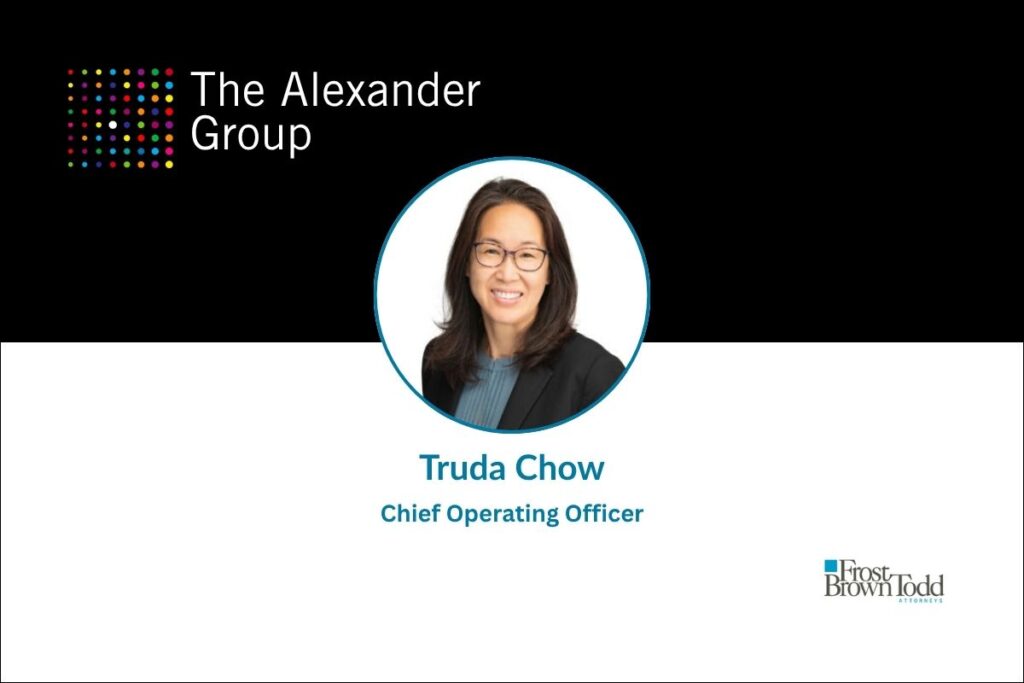
Frost Brown Todd LLP appoints Truda Chow to lead strategic operations across its national platform.
Frost Brown Todd LLP, a full-service law firm with offices across the United States, partnered with The Alexander Group, a global executive search firm, to recruit a Chief Operating Officer. As the firm continued its strategic growth across key markets, it sought a proven operational leader to unify systems, elevate performance, and guide it through the next phase of scale.
Key Leadership Need
Frost Brown Todd sought a candidate with a global mindset and deep law firm operational experience. Their role required a leader able to manage firmwide strategy, optimize cross-office performance, and serve as a key advisor to executive leadership on infrastructure, client service delivery, and growth planning.
The Alexander Group’s Approach
Led by John C. Lamar and William V. Lepiesza, the search targeted operational leaders with experience across law firm management, consulting, and professional services. The focus was on candidates with cross-functional expertise and the ability to lead in complex, distributed organizations.
Search priorities included:
Proven success leading national or global operations at law or professional services firms.
Experience in legal process improvement, operational alignment, and firm scalability.
Strategic insight into business growth, M&A, and systems modernization.
Truda Chow emerged as the standout candidate, having served in COO roles at Clyde & Co and Michael Best and senior consulting roles at LawVision and Hildebrandt International. Her cross-industry background—from legal to global consulting to high-tech—gives her a unique lens on optimizing firm operations across borders and functions.
Successful Placement and Impact
Truda Chow will lead operational performance, firm integration, and strategic execution across a 14-office footprint. She will partner with firm leadership to drive scalable solutions in service delivery, infrastructure, and internal operations.
Immediate Impact:
Aligns firmwide operational strategy with business and client priorities.
Modernizes administrative systems and workflows for performance and efficiency.
Strengthens internal leadership collaboration across practice and business units.
Supports scalable infrastructure as the firm continues national expansion.
Insights from the Recruiters
“Truda is a highly accomplished, senior executive who has led significant growth, innovation, and business transformation for major law firms throughout her career.”
– William Lepiesza, Director, The Alexander Group.
About Frost Brown Todd LLP
Frost Brown Todd LLP is a full-service law firm with more than 575 attorneys across 14 offices nationwide. The firm serves clients in key industries including financial services, energy, technology, health care, and manufacturing. Known for a strong commitment to collaboration, client service, and forward-thinking legal solutions, the firm is consistently recognized as one of the top firms in the U.S.
About The Alexander Group
The Alexander Group is a global executive search firm based in Houston. With a strong track record of placing operational and strategic leaders across Am Law 200 firms and professional services organizations, the firm specializes in helping clients build the leadership infrastructure needed to grow and compete.
Operational clarity starts with executive alignment. The Alexander Group helps law firms find the leadership that powers performance.
A young manager presenting the graph results on the whiteboard to the board at the conference room.
In our ongoing series covering various aspects of attaining a board seat, we continue with tips on acing the board interview.
First Things First The Initial Interview with the Search Firm
The search firm will be vetting several candidates. Today, almost all board searches have specific functional requirements for which the search firm will look. Gone are the days when companies sought an astute business person who would mesh with the existing board. You will likely be competing with executives with similar talents and experience.
The recruiter will not review your resume in the same manner as if you were interviewing for an operational position within the company. Instead, the recruiter will look for the high points: What were your successes when facing challenges? What was the culture at your organization, and why did you make confident career choices? What was your reputation at each company where you worked? Are there explainable career gaps? The recruiter will pay particular attention to your interpersonal style, silently assessing if you would be a good fit and if your experience and skill set would complement the current board.
The recruiter will also want to discuss your past board experience and pose questions demonstrating your knowledge of a board and how it functions. I have seen many good candidates fall short of the interview by discussing “their desire to help management run the company better.”
We cannot say it too many times: directors do not help manage the company. They represent the interests of shareholders and provide oversight and guidance on issues such as creating and preserving shareholder value, executive compensation, enterprise risk management, CEO succession, and maintaining corporate integrity.
If you do not have public board experience, do some research. Ask your friends or colleagues who are board members what they were asked by the search committee and would ask of a prospective board candidate.
The recruiter will also confirm that you have the bandwidth to take on another role, autonomy over your schedule and that your company endorses you joining an outside board. You should have reviewed the board meeting dates for the next two years and confirmed your availability.
Speaking of time, I have two observations:
One red herring that a candidate is not the right fit for a public board is his or her accessibility. Board-ready executives know how to manage their time and calendar. Several years ago, while conducting a board search, an executive was very excited about joining my client’s board but was unable to discuss the opportunity by phone until the following month. My concerns increased after I scheduled a time to fly to Los Angeles to interview her at her office. Her assistant told me she would have only an hour to meet with me. Be mindful that if you are considering joining a board, you are excited about, demonstrate that you will invest the time at the front end with the search firm. This will help assure that adding this additional time commitment is the right decision for you and the company.
Lastly, the recruiter may ask if there is anything that a background check would reveal that could be an issue. Obviously, in addition to criminal records, the recruiter wants to know if you have been the subject of any lawsuits, especially a shareholder suit, and the subject of any SEC or other regulatory proceedings.
Company Interview – What You Need to Know:
1. It may be a lengthy process. Very few boards conduct searches with tight deadlines. Quite the contrary. I’ve conducted searches in which the timeline to complete the search was a year. Because retiring board members give ample notice, or, if a board is adding a new member, it may wish to consider a wide slate of diverse candidates. Additionally, the long process is simply a matter of logistics. Most board members and candidates don’t reside in the same city or where the company is headquartered. During my last board search, we flew the candidates and the nominating and governance committee to New York for candidate interviews. Only one out of the nine individuals lived in New York, but it was the most central and easily accessible location.
Your first meeting with the company could be with one director or the chief executive officer. It will likely be with a group from the company’s Nominating and Governance (N&G) Committee. We have previously written about how to ace a search committee interview; however, there are some twists for the N&G Committee interview, which I discuss in in the following points
2. The basics. Before you don your best suit or dressiest office attire, ask the search firm what the committee will be wearing. You will want to dress accordingly. Some candidates have gone to interviews in their most conservative suit only to find the N&G Committee dressed in khakis and golf shirts. On the other hand, one particularly self-assured candidate wore jeans to the interview and the board members all wore suits. You don’t want to draw attention for over or under dressing. Always ask and match your attire to those with whom you meet.
3. Preparation. In addition to reading the company’s financial documents, analyst reports and regulatory filings, it is critical that you connect with the company’s “product.” Visit the stores, eat the food, etc. Who are you meeting with? What is their tenure on the board? Take a step back and look at the board as a whole. Is it a long-tenured board? Is there frequent turnover? What apparent strengths does each member bring to the board? What are the company’s long-term plans? Where could you add value? Time spent reading the MD&A and Management sections in the company’s 10-K, about the directors in its proxy statement, and the responsibilities of directors in the bylaws will be invaluable.
4. Striking the right tone. As we have said, interviewing for a board position is different from interviewing for an executive role at a company. You do not need to discuss each position you have held throughout your career in granular detail, but give an overview of how you have increased earnings, introduced new products, restructured a company, led global expansions, etc. — how you have added value to the enterprise.
5. Use your time wisely. Assume you will be asked for a five-minute summary of your background. Avoid getting into the weeds. Highlight the strengths you bring to this board seat. For example, if a board is interested in you because of your turnaround experience, spend proportionately more time discussing that than your experience taking companies public. If this would be your first board role, highlight your interaction with the boards of companies with whom you have worked.
6. Interviewing with a Nominating & Governance Committee. The primary mistake many candidates make is not giving concise answers. It is also essential to make eye contact with each committee member when answering a question. Not only does it make everyone feel included, but it allows you to assess body language to see if you are talking too much or if there is a lack of interest in what you are saying. Don’t be afraid to say, “Please stop me if my answers are too long or if you want more detail.”
7. Giving feedback on the company. One possible question may be, “What is your opinion of our product, stores, strategy, or challenges?” Your answer will demonstrate how well you have done your homework. If there are weaknesses, you should point them out constructively and tactfully yet balance them with positives. You will be assessed on how well you can give constructive feedback without being abrasive. Conversely, some candidates make the mistake of being overly enthusiastic and gushing about a company and offering nothing but compliments. This can also be a disqualifier, as every company can improve in some area and board members must be able to offer balanced feedback.
8. Your reasons for being a candidate. We have addressed the issue of candidates understanding the role of a board member. But what should you not say? Your reasons for serving on a board should not be about you and what the position will add to your resume, career, or pocketbook. One board reported that a candidate wanted to retire in a couple of years and then fill his time with board positions, hoping this would be the first one. Instead, your motivation should be about how to add value and why the company has the product, challenges, or culture you identify with.
9. Ask questions. Your questions are as important as your answers. Ask questions demonstrating you understand the issues the board has faced or could in the future. Ask questions that will require answers by more than one board member and could potentially result in a deep discussion. Good candidates should demonstrate knowledge of the business, have critical thinking skills, and be collegial so that the committee leaves thinking, “I could see her on the board. She seems like a good fit.”
Final thoughts Remember that the interview is on a two-way street. Regardless of how much you covet that first board seat, the time commitment is too expensive if you feel uncomfortable with or align with the other board members.
What do Walmart, Berkshire Hathaway, Dell, Comcast, Publix, and Ford have in common? All are among the nation’s largest companies and members of the Fortune 100. Each of them is “family-owned,” which is loosely defined as having two or more family members involved and a majority of ownership or control within the family. Family-owned businesses date back centuries to family farms and, in urban settings, shops, and businesses where the family lived above the premises. In both examples, all family members actively participated in producing the family’s livelihood.
Although many people think of family-owned businesses as making up only a small part of the economy, the following 2021 statistics from Family Business reveal that family-owned businesses:
Employ 23 percent of the US workforce, accounting for 32.6 million jobs; Generating 23 percent of private-sector GDP or $3.2 trillion; and Total 9.1 million businesses, representing 25 percent of all business tax returns. Pressure to Keep it in The Family—Challenges in Hiring Family Members:
The family-business owner, like all business owners, should be concerned about having the best talent in appropriate roles. This can pose a challenge when hiring family members for key positions. Are they the best qualified? It is important to establish hiring and position requirements and uniformly adhere to them when considering family. These guidelines help avoid the pressure to hire a family member only because they are a family member. Many family companies encourage the next generation of family interested in the business to work for another company for several years to gain general business knowledge and experience to be eligible to join the family business.
When family members choose to work for another company in the same industry, they gain added perspective and familiarity with accepted industry-specific best practices. Family members who work outside the family business can gain increased credibility with other family members and the board. Family businesses should communicate hiring criteria for all positions, which not only sets the standard for talent management but can avoid future misunderstandings and conflicts.
The family business owner should ensure that every employee, whether a family member or not, receives the training needed to allow them to function successfully. Placing a family member in a role for which they lack the appropriate skills without a plan to provide the needed training can cause tension, low morale, and family drama. Family member executives must be assessed on their own merits. Each position should have yearly goals so that the family member can be evaluated objectively and without favoritism.
Strategically Hiring Outside The Family:
Hiring nonfamily members, especially doing so for the first time, can be challenging. Many companies decide to hire nonfamily members when the owners want to accelerate the company’s growth. Other companies hire nonfamily members when the company needs specific skills such as legal, international, or financial expertise. The challenge then becomes ensuring that the nonfamily member is a good fit with the organization’s culture and the family itself, especially if the company is small. Marc Sharpe, Chairman of the Family Office Association, reports that individuals who are comfortable with a “servant leadership style” in which one leads by putting the needs of their team first can be an excellent personality fit for a family business.
He adds that while hiring a nonfamily manager is often done to acquire a specific skill set, it is also important to hire individuals who have the flexibility to take on a generalist role when needed. If companies are recruiting nonfamily members for a position to replace a family member, it is important to communicate the reason for the hire and have detailed position requirements. If the company’s management are not in full agreement to hire a nonfamily executive, it will be a difficult and possibly unsuccessful hire.
To avoid and resolve family conflict, it is important in the recruitment and retention of outside candidates to ensure the family business has well-defined business procedures and corporate governance. Also, making decisions informally outside the office will put the nonfamily member at a disadvantage.
Best Practices for Executives Joining a Family Business:
Individuals who work for family businesses agree that it can either be a rewarding or disappointing experience depending on a number of factors, and we recommend that any executive considering joining a family business evaluate the following:
Has the family agreed on the hire? How well has the position been defined? How many individuals have previously held the same position? Turnover, particularly in the C-suite, can be a red flag indicating that the family is not ready for a nonfamily executive; How are business decisions made? Cultural fit may be influenced by whether the business owner makes key decisions independently or in a distributed fashion; How does the team operate in terms of executing the business? A well-functioning team is empowered to operationalize projects and business imperatives timely and successfully; Understand the business owner’s goals; recognize these goals may be focused on objectives other than increasing revenue and growth, such as philanthropy or creating a legacy; Evaluate the strengths and challenges of the current team and look for signs of dysfunction among family members; Get to know family members individually, because they may have different goals and objectives; what are the family dynamics in play?
The Alexander Group, a leading financial executive search firm, recently completed a successful placement for Lisinski Law. This effort highlights our expertise in sourcing top legal talent and matching it with leadership needs within law firms.
Key Points:
The Alexander Group demonstrates expertise as a top financial executive search firm.
Successful executive recruitment for a financial role at Lisinski Law by The Alexander Group.
Introduction of Jill Yutzy Coen at Lisinski Law as Vice President of Legal Operations.
Strategic Financial Executive Placement for Leadership Excellence
Jill Yutzy Coen has joined Lisinski Law as the newly created Vice President of Legal Operations. Ms. Coen is an experienced operational leader with a core skill set that includes regulatory expertise, compliance, risk management, litigation, and reporting. Before joining Lisinski, Ms. Coen was the Executive Director of Regulatory Operations at JPMorgan Chase & Co.
The Alexander Group’s expertise as a financial executive search firm has allowed us to understand the complexities of placing top-tier financial talent in leading roles. The Alexander Group worked closely with Lisinski Law to identify key competencies required for executive recruitment for a financial role. This ensured that Jill Yutzy Coen was an ideal fit for their firm’s strategic needs.
“Jill’s experience as a practicing attorney and an operations leader made her an ideal candidate for this role. As the assignment progressed, it became clear that there was a strong alignment in philosophy between Jill and the team at Lisinski, and we look forward to seeing the impact that Jill can have now that she has joined Angel and her team at Lisinski Law,” said Jonathan Verlander, Managing Director, The Alexander Group.
Established in the fall of 2020, Lisinski Law is a swiftly expanding immigration law firm that has already served over 15,000 clients and built a strong record of success in handling complex immigration cases. The firm’s dedicated attorneys bring extensive trial and immigration expertise and impeccable reputations to clients nationwide—often representing those turned away by other firms.
With a team of 700 professionals, Lisinski Law primarily assists clients in securing legal status through humanitarian-focused immigration cases, such as T-Visas for victims of human trafficking, U-Visas for crime victims, and VAWA relief under the Violence Against Women Act for survivors of abuse or extreme cruelty.
Financial Executive Search Firm Specializing in Legal Sector Leadership Placements
As a top financial executive recruiter, The Alexander Group takes pride in delivering outstanding recruitment services that meet the specific needs of the legal industry. Our track record with Lisinski Law is a testament to our commitment to excellence in executive placement for law firms.
We are dedicated to cultivating enduring partnerships with our law firm clients. This relationship affords us a profound understanding of each firm’s distinct culture and requirements, enabling us to employ innovative strategies that transcend conventional legal boundaries in order to secure the most suitable candidates.
This search was conducted and completed by Managing Directors John Mann and Jonathan Verlander. Read more about our expertise as a financial executive search firm.
The Alexander Group, recognized as one of the top CEO executive search firms, presents “Five Questions With Outstanding Leaders,” our series where we interview visionary industry leaders. In this edition, we speak with Jonathan Horowitz, President of the Houston Hospitality Alliance, about key challenges, successes, and future opportunities within the hospitality sector.
Houston offers every global cuisine, and diners are only too happy to explore and experience what the city is serving.
However, Houston’s hospitality and tourism are more than its vibrant dining scene.
Just ask Jonathan Horowitz, president of the Houston Hospitality Alliance.
Managing Director John Mann of The Alexander Group, one of the nations’s top CEO executive search firms, sat down with Horowitz to discuss the business of Houston’s hospitality and tourism industries–struggles, successes, and the future.
Executive Leadership Recruitment for Hospitality: Horowitz’s Vision for Houston Hospitality Alliance
Horowitz’s deep experience within the hospitality industry and his background as an attorney and real estate agent made him the ideal hire for the high-profile president position. The HHA is an organization that strives to promote, connect, and energize Houston’s hospitality and tourism business and create industry success in Houston.
For more than 17 years, Horowitz developed, operated and led multiple marketing restaurant/bar concepts, including Legacy Restaurants (Original Ninfa’s on Navigation Tex-Mex restaurant and the Antone’s Famous Po’Boy sandwich concept) Lasco Enterprises, LLC (The Tasting Room Wine Cafe, MAX’s Wine Dive, Boiler House Texas Grill) Midway Hospitality Development and Convive Hospitality Consulting, a full-service hospitality consulting service. He received a Bachelor of Arts degree from Rice University and a JD from South Texas College of Law.
Mr. Horowitz was a corporate executive search firm’s ideal candidate, and since being named HHA president in October 2023, Mr. Horowitz has addressed Houston City Council members at City Hall, discussed the Houston Hospitality Alliance and its mission to promote, represent, and advocate for the entire hospitality industry in Houston, and led the HHA Business Forum.
Horowitz is an ardent community supporter of many organizations, eager to illuminate the city while growing the HHA.
“I am thrilled that Jonathan joined the Houston Hospitality Alliance as the new President, bringing with him over two decades of leadership and innovation in the hospitality industry, as well as a deep-rooted commitment to the Houston community,” said Mann.
Challenges in Hospitality Leadership Recruitment: Navigating the Changing Houston Landscape
JM: Let’s discuss opportunities and challenges concerning hospitality development within the Houston landscape.
JH: We currently are in the most challenging environment ever for the entire hospitality industry. Prior to the pandemic, things were in a pretty good place; however, the pandemic changed everything for the industry. There are a few areas where hospitality continues to struggle:
The overall cost of doing business—everything is considerably more expensive than it’s ever been. The cost of goods, labor, rent, insurance, and just about everything else has increased dramatically and shows little sign of slowing down anytime soon.
Labor shortages—the industry lost millions of workers during the pandemic, and many have not returned. It’s been difficult, and it will take a long time to organically replace them in the labor cycle.
Changing consumer habits—Consumers now demand more efficiency and value when considering hospitality purchases. Technology advanced considerably during the pandemic, making it easier to obtain things quickly and cheaply, and consumers are demanding more for less. This stresses an already stretched system.
Overall competition—while many operations have closed, a slew of new companies have opened here in Houston. New restaurants and hotels appear every day and create a more competitive environment for all involved. Notwithstanding the fact that our population continues to grow, there are only so many customers to go around.
JM: Houston is a destination for new businesses and conventions. How do you take advantage of that momentum moving forward?
JH: It’s all about providing a complete and memorable experience. Consumers expect more and more now, so they have to be “wowed” once they’re here. Many people have preconceived notions of Houston and don’t realize how diverse, cosmopolitan, and exciting the city really is. Once they get here – for whatever reason (business, pleasure, a convention, the Med Center, etc.), they come away with a great appreciation for what Houston offers. The overall hospitality industry in Houston is extremely strong, and once people get here and experience it, there’s a good chance they’ll come back.
JM: The Greater Houston Partnership’s latest data reports that almost 11% of Houston’s employment is in the Leisure and Hospitality sectors. How do you grow that industry?
JH: It’s happening – see above. New places are opening every day, and companies from all over the country are coming here because they recognize the great opportunities here.
JM: How does your background as a hospitality business professional and an attorney support your role as HHA president?
JH: I am fortunate in that I’ve seen both sides of the industry – having been an owner and operator, I can understand and empathize with those who are running hospitality businesses in the city, and I’ve been involved in a restaurant trade association for nearly two decades. These perspectives help me on a daily basis to help guide the HHA. As for being an attorney, that helps me all the time – not only with work but with general life issues. It’s a great education and experience to have, and it gives me a better understanding of how to deal with people, contracts, and potential disputes.
JM: What are the next steps of growth for the HHA?
JH: We are focused on growing membership every day. Just this year, we’ve doubled the number of members and are not slowing down. We recognize that, in order to keep members engaged and to attract new ones, we need to provide great value. We have four primary value propositions as an association:
Promotion of the Houston hospitality industry locally.
Advocacy on behalf of the industry in Houston.
Connection – providing the members of the industry the opportunity to connect with each other, share best practices, engage in business together, and find community with each other.
Education—We provide educational opportunities for industry members to learn more about issues and topics key to their businesses’ success.
Continued Excellence in Executive Leadership Recruitment
As one of the top CEO executive search firms, The Alexander Group continues to engage with and learn from industry leaders like Jonathan Horowitz. By fostering deep relationships and understanding the specific needs of each client, The Alexander Group remains committed to elevating the quality of executive talent acquisition across industries, ensuring visionary leadership for businesses poised for growth.