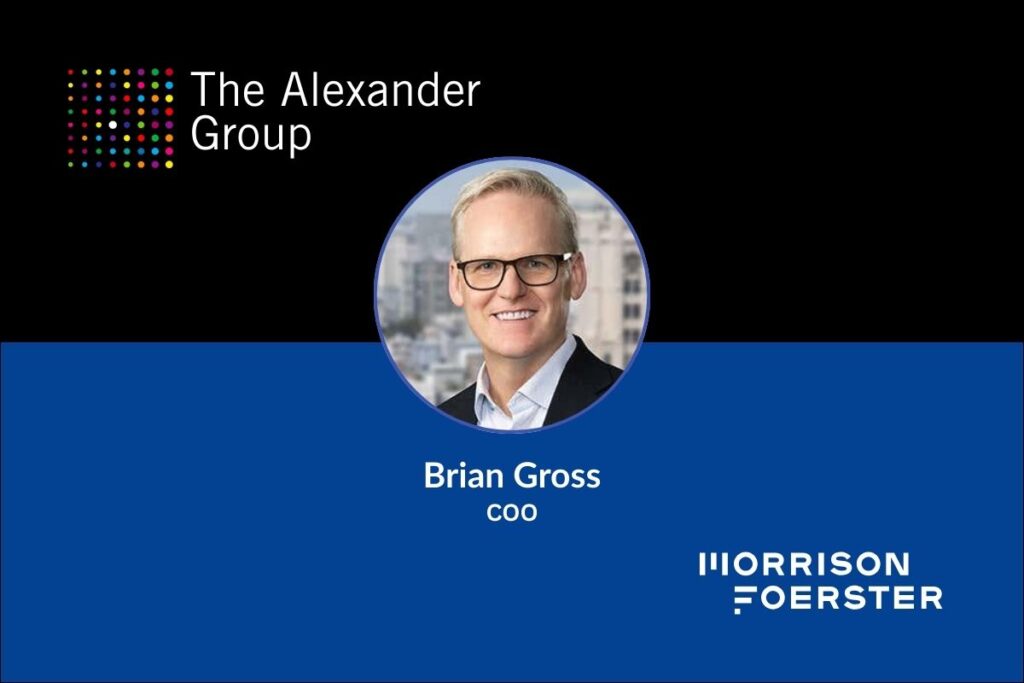
Morrison & Foerster LLP (MoFo), a premier global law firm recognized for its work in technology, life sciences, finance, and litigation, partnered with The Alexander Group, a global executive search firm, to recruit a Chief Operating Officer (COO). As Morrison & Foerster continues to scale its international operations and deliver innovation-driven client service, the firm sought an experienced leader to optimize its business functions, drive operational excellence, and support long-term strategic growth.
Key Leadership Need
The firm required a Chief Operating Officer who could oversee the firm’s operational, financial, administrative, and marketing functions on a firmwide basis. The ideal candidate would enhance collaboration across practice groups and business services, strengthen internal systems, and align firm operations with Morrison & Foerster’s global growth strategy while maintaining its culture of innovation and service excellence.
The Alexander Group’s Approach
Managing Director John Lamar and Director Sarah Mitchell led a targeted executive search, focused on identifying operational leaders from top-tier law firms and professional services organizations.
Key priorities included:
Proven leadership across finance, HR, IT, marketing, and administrative operations
Expertise in driving business growth, operational transformation, and strategic initiatives
Success leading cross-functional teams and fostering collaborative, high-performance cultures
Brian Gross was selected for his strategic leadership at Boston Consulting Group (BCG), where he served as COO for North America and Managing Director and Partner, as well as for his proven ability to build high-performing teams and operationalize firm-wide growth strategies.
Successful Placement and Impact
Brian Gross joined Morrison & Foerster LLP as Chief Operating Officer. With over two decades of leadership experience across professional services, including BCG and prior business development and recruiting leadership roles, Brian now leads MoFo’s financial, operational, marketing, and administrative functions globally.
Immediate Impact:
Strengthening alignment of business operations with firmwide strategic initiatives
Optimizing internal processes to support cross-office collaboration and client service delivery
Building operational teams and infrastructure to sustain long-term growth and innovation
Insights from the Recruiters
“Brian’s extensive experience as a senior operations executive, his demonstrated ability to build and lead teams, and his strong strategic skills will serve Morrison Foerster well as the firm continues to expand its global platform.”
— John Lamar, Managing Director, and Sarah Mitchell, Director, The Alexander Group
About Morrison & Foerster LLP
Morrison & Foerster LLP is a leading global law firm with more than 1,000 attorneys across 17 offices worldwide. The firm is widely recognized for its innovation, diversity, and outstanding client service across sectors including technology, life sciences, finance, and litigation.
About The Alexander Group
The Alexander Group is a global executive search firm and an executive search firm in Houston. The firm serves industries including legal services, life sciences, healthcare, financial services, energy, technology, consumer goods, and nonprofit organizations, delivering strategic, results-driven leadership placements tailored to each client’s needs.
Wiley Rein LLP, a nationally recognized law firm renowned for its expertise in regulatory, litigation, and government affairs, has partnered with The Alexander Group, a global executive search firm, to recruit a Chief Financial Officer (CFO). As the firm continued to expand its national footprint and practice capabilities, it required a seasoned financial leader to optimize financial operations, implement scalable processes, and drive data-informed decision-making.
Key Leadership Need
The firm needed a CFO who could oversee all financial functions, including budgeting, financial reporting, forecasting, client funds management, billing and collections, and audit oversight. Wiley sought a leader capable of strengthening financial performance, modernizing internal accounting systems, and supporting strategic growth initiatives across multiple practice groups.
The Alexander Group’s Approach
The Alexander Group conducted a targeted national search for finance executives with deep expertise in professional services operations, particularly within the legal sector.
Search strategy highlights:
Identified CFOs experienced in budgeting, projections, client pricing models, and audit oversight
Prioritized candidates with a strong background in law firm accounting systems and financial reporting
Emphasized leadership skills in managing financial teams and driving operational improvements
Brad Bonneau emerged as the top candidate based on his extensive financial leadership experience at Chapman and Cutler LLP, where he served as CFO, and his proven ability to modernize finance functions while mentoring and developing professional accounting teams.
Successful Placement and Impact
Brad Bonneau joined Wiley Rein LLP as Chief Financial Officer. He brings over two decades of financial leadership experience in the legal sector, including financial planning and analysis, budgeting, client fund management, tax compliance, and optimization of accounting systems.
Immediate Impact:
Initiated upgrades to financial reporting and internal accounting processes
Strengthened budgeting and forecasting accuracy across the firm
Developed streamlined models for client billing and alternative pricing strategies
Enhanced collaboration between finance and practice leadership teams
Insights from the Recruiters
“Brad is the ideal strategic business partner to Wiley’s forward-thinking executive team.”
-Amanda K. Brady, Managing Director/Chief Client Officer at The Alexander Group.
About Wiley Rein LLP
Wiley Rein LLP is a Washington, D.C.–based law firm with more than 240 attorneys practicing in areas such as telecom, insurance, government contracts, and public policy. Known for its focus on regulatory and litigation matters, the firm has earned a strong reputation for delivering strategic client solutions.
About The Alexander Group
The Alexander Group is a global executive search firm with offices in Houston and other U.S. cities. Serving industries including legal services, life sciences, healthcare, financial services, energy, technology, consumer goods, and nonprofit organizations, The Alexander Group specializes in delivering strategic, results-driven leadership placements tailored to each client’s needs.
The benefits of board membership extend far beyond prestige or compensation; they offer executives a chance to grow professionally, make meaningful contributions, and build valuable networks.
However, serving on a public company board is not as easy as it once was. Increased regulatory pressures, shareholder scrutiny, and the risk of litigation have elevated board members’ responsibilities.
Despite these challenges, many public companies continue to attract highly competent directors. Why is this so? Because the opportunities and rewards of board membership make it a compelling career move for many executives.
Seven Benefits of Board Membership
The benefits of board membership are as diverse as the professionals who seek them. From career advancement to personal fulfillment, board service offers executives opportunities to grow, contribute, and connect meaningfully.
In this section, we’ll explore seven compelling reasons why board membership remains an attractive goal for many leaders.
1. A way to segue into retirement.
As executives move into the last third of their careers, many start planning their retirement and what they will do to fill the time. If we had a dime for every executive who says, “Once I retire, I’d like to sit on a couple of boards,” our coffers would overflow.
With board memberships, a retired (or nearly retired) executive can have a place in the business world but on a more limited and structured basis. No analyst meetings, no customer presentations. Just three days a quarter, often in a nice location. As one executive said, “I don’t want to practice, but I still want to be in the game.”
2. Best practices.
Many executives in the prime of their careers want to be on a board so they can learn from other executives and see what works for a different company, industry, or culture. Susan R. Nowakowski, President and CEO of AMN Healthcare Services, says that a board position should allow executives an opportunity to be constantly challenged and grow professionally.
She adds that directors should “get involved in addressing the organization’s key strategic issues by joining, and perhaps even chairing, the board’s strategic planning committee because strategic acumen and leadership abilities are valued in the business world.”
3. Connect with other executives.
There are many executives who like being exposed to other executives—whether for business reasons or simple networking reasons. It is not uncommon to see some potential board candidates choose to join a board based on the perceived caliber and stature of the other board members.
Similarly, we have conducted searches where prospective candidates have commented that the board we were recruiting for was “not high wattage” enough for them.
4. Compensation.
Make no mistake: serving on a public company board can provide attractive compensation, leaving many professionals wondering, ‘How much do board members make?’
With roughly 20 work days a year, board members can earn substantial fees, often supplemented by stock options. While many companies award a portion of board fees in the form of stock options, the potential for stock appreciation can also be a strong incentive.
Top corporate board earner Shirley A. Jackson, who sits on six Fortune 500 boards, including FedEx, Marathon Oil, and IBM, took home more than $4 million in board compensation from 2008 to 2010.
5. Prestige.
Right or wrong, some executives see a board seat as one more rung in a successful career. We have met executives who don’t have the time or, truth be told, the attention to detail that a board requires, yet still, they believe they are missing something by not serving. It’s almost like the corporate version of “Keeping Up with the Jones.”
Listen carefully, for the stories are plentiful of board members ever so quietly being asked to leave for not attending board meetings or being unprepared.
6. Strategic career move.
Many executives believe that board service will provide greater visibility, making them more sought after for a higher position with another company. This seems especially true with non-CEOs. We know a former CFO of a utility company who landed a spot on a Fortune 50 consumer products board. Many years later, while being considered for the CEO position of his business, he beat out someone with much more experience because the board believed his knowledge as a board member for another company would make him more effective at managing their board. Along these lines, some companies choose their CEO from their existing Board members.
While most board members don’t join a company board hoping to be its CEO, it does happen. Betsy Burton, the former CEO of Supercuts, sat on the board of jewelry retailer Zale Corporation for three years before being selected as President and CEO. From July 2009 to October 2010, twelve Fortune 1000 companies selected their new permanent or interim CEO from their board ranks, up from only four the year before, and the trend is only growing.
Depending on their expertise, executives can pick from a list of executive board positions such as Chairperson, Treasurer, or strategic committee leadership roles, expanding their career opportunities through targeted board memberships.
7. Opportunity to serve.
Some executives don’t care about any of the above reasons but want to serve; they believe they have the wisdom and experience to add value to a particular organization. As Thomas M. Gorrie, a renowned international health policy adviser, said when he was selected to join The Robert Wood Johnson Foundation’s board of directors, “I am eager to lend my experience and passion…to help continue the foundation’s reputation for innovation and excellence and to play a role in helping achieve lasting change in health and health care.”
Executives drawn to service often find fulfillment in the responsibilities of a board member, which include providing governance, offering strategic oversight, and ensuring the organization’s long-term success.
Maximizing the Benefits of Board Membership: Your Next Professional Move
Board service offers a unique blend of professional growth, personal fulfillment, and career advancement opportunities. From leveraging your expertise in a strategic capacity to building meaningful connections with other leaders, serving on a board can be a pivotal step in your professional journey. Whether you’re nearing retirement, seeking a new challenge, or simply want to contribute your knowledge and passion to a worthy organization, the benefits of board membership are as diverse as the roles themselves.If you’re considering board service as your next professional move, The Alexander Group can help you navigate the process. With decades of experience in executive search and board placements, we specialize in matching exceptional leaders with organizations that align with their values and expertise. Contact us today to explore how we can support your transition to board service and help you find the perfect fit for your skills and ambitions.
Board member communication is a critical skill that can shape the effectiveness and dynamics of any board. From asking thoughtful questions to influencing decisions through collaboration, how an effective board of directors communicates often determines its success.
This guide is the third in our series exploring proven strategies for helping first-time and seasoned board members refine their communication styles and build stronger connections. If you missed our previous posts, you can find part one here and part two here.
6 Board Member Communication Tips
One of our readers suggested that you think of your first board as if you are being introduced to your spouse-to-be’s family. Maybe that is not the perfect analogy, but first impressions are hard to counterbalance should you make a mistake.
As a board director, how you communicate is just as important as what you do. Successful directors think before they speak and influence their peers instead of making demands. Continue reading for more expert advice on effectively communicating as a board director.
Question in the right way.
Think before you speak. Ask yourself:
What is my intent?
What is my objective?
One savvy director says he phrases his questions to promote discussion and allow the board to examine the issue more deeply.
You need not always ask the first question or make the first comment on a topic. There will be times when you can offer more by listening first to what others have to say. As we noted previously, refrain from asking questions merely to get information you should already have; in other words, do your homework so you don’t have to use meeting time to get up to speed. If you have unanswered questions, schedule one-on-one calls or meetings with the CEO or other directors before the meeting and during breaks.
Be time-conscious and make every moment count.
Know what matters and what does not because time is limited. One veteran director comments, “There is always a director who wants to monopolize the conversation and listen to himself talk. Don’t be that person.”
Stick to the essentials for effective board meetings and action. If the conversation derails, gently guide everyone back to the topic. Details matter and often merit discussion, but avoid “the weeds” unless the issue is the weeds. Those are better left to management.
Be open to adapting your board member communication style.
You will have a different kind of authority than a director on your first public board as a CEO, where you have the final say. A board meeting is not a staff meeting where you make unilateral decisions and assign tasks. One director, a managing partner at a private equity firm, confessed that after being on the board of portfolio companies where he didn’t have to share power with others, joining a public board required him to modify his style to stop giving orders and rely more on influence.
Because boards act collectively and not individually, effective directors must act through persuasion, convincing others of the merits—and the risks—of a particular decision. Becoming an influential board member requires understanding how other directors receive and process information. You will never finish refining your ability to influence.
Be careful about how you discuss previous experience.
Use your experience as an executive officer at other companies without constantly referring to it. As one director said, “It is very annoying for someone to continually say, ‘At ABC company, we always did this.’” Constantly bringing up your experience as an executive may turn off management and your fellow directors.
Instead, one veteran director suggests asking open-ended questions that compare strategies. “Could there be a better way to do this?” works much better than “At my company, we do it differently.” Balancing input and collaboration with others is one of the key responsibilities of a board member. This ensures that your experience adds value without overshadowing group dynamics.
Ask for feedback.
Director communication should be on a two-way street, not limited to the boardroom or committee room. Most boards have a formal director evaluation process; let that assessment be an ongoing process and seek out the views of other directors on a range of relevant matters. One of the most valuable things a new director can do is ask for feedback on their board participation after the first or second meeting. If you are talking too much, focusing on the wrong issues, or crossing the line on management responsibilities, learning it quickly to adapt is better. Seeking constructive feedback is a vital step in learning how to be a good board member, helping you identify areas for improvement and build stronger relationships with fellow directors.
Provide feedback—but do it respectfully.
After you have gained experience serving on the board, be a helpful leader to any new directors. An experienced board director suggests providing positive feedback to new board members by starting with positive recognition: “I like the way you did this. However, when you said that, you turned the management off. Is there a better way you could approach that?” Many first-time board directors may be insecure initially; the seasoned director has an opportunity to mentor and guide the new director to be effective. Understanding what makes a good board member involves fostering open communication, offering peer support, and continuously improving your ability to collaborate.
Effective Board Member Communication Can Enhance Your Leadership
Mastering board member communication is essential for building trust, fostering collaboration, and driving effective decision-making within any board. You can elevate your contributions and influence as a director by asking thoughtful questions, adapting your style, and providing constructive feedback. If you’re ready to enhance your board’s leadership and find directors who excel in communication and collaboration, The Alexander Group can help. Contact us today to learn how our executive search expertise can support your organization’s success.
Lauren Elkhoury has joined Vinson & Elkins as Director of Pricing and Rates. Ms. Elkhoury is a cross-functional leader with extensive experience identifying and planning strategic initiatives to maximize revenue and profitability competitively.
Prior to joining Vinson & Elkins, Ms. Elkhoury Director, Practice Operations for Norton Rose Fulbright US LLP in Houston, Texas. Ms. Elkhoury received a Bachelor of Arts in Political Science from Tulane University.
“Lauren is a seasoned legal professional who will bring years of legal project management, pricing, and practice operations experience to Vinson & Elkins. She is known for her ability to plan strategic initiatives to maximize revenue and profitability competitively,” said Anthony Ott, Senior Associate, The Alexander Group.
Managing Director John Mann and Senior Associate Anthony Ott conducted and completed this search.
Vinson & Elkins LLP is one of the largest and most successful law firms in the United States, with approximately 700 attorneys. V&E consistently ranks as one of the most profitable law firms and is ranked 25th in the Am Law 100 with respect to 2023 based on profit per equity partner.
Collaborating seamlessly across 11 offices worldwide, V&E provides outstanding client service. The Firm’s lawyers and other professionals are committed to excellence, offering clients experience in handling their transactions, investments, projects, and disputes across the globe. Established in 1917, the Firm’s time-tested role as trusted advisor has made V&E a go-to law firm for many of the world’s leading businesses and investors.
Executive job search tips can make or break your chances of landing a leadership role, especially when working with executive job search firms and experienced recruiters.
Understanding executive job interview tips and showcasing qualities of professionalism are essential steps in setting yourself apart from other candidates. After all, professionalism in the workplace isn’t just about appearances—it’s about ensuring your actions align with your words and reflect your capabilities as a leader.
How to Lose Jobs and Alienate Interviewers
Generally, most successful senior executives are adept and experienced at the executive search process, but not all. And the exceptions have stood out vividly. Here are a few real-life examples of executive behaviors that have left these executive search professionals less than impressed.
Four Insights to Help You Succeed in the Executive Recruitment Process
Match your talk to your walk.
Little things make a big impression.
Where was I? Oh, yes…Stay on point.
Where there’s a will, there’s a way.
Match your talk to your walk.
How you conduct yourself during the search process speaks volumes about how you engage as a professional and business leader. It is an opportunity to “walk the walk,” not just “talk the talk.”
A Chief Operating Officer may say that he is “highly analytical, data-centric, and impeccably precise,” but if he repeatedly asks for schedules and agendas to be re-sent, does not remember the names of people he has met with, product lines, or critical business metrics; and (despite multiple corrections) continues to bafflingly mispronounce the company’s two-syllable name—your actions are speaking louder than your words.
Likewise, if you’re
a Chief Information Officer who has never used FaceTime, WebEx, or Skype;
a Chief Communications Officer and your resume is one solid block of text with mismatched fonts;
a Chief Accounting Officer and can’t work out the calculations on a travel reimbursement form,
you aren’t projecting the level of functional expertise commensurate with your profession.
Little things make a big impression.
Details matter, and making sure the fine points and “little things” are covered and done correctly is essential for success—as a Chief Executive Officer candidate recently learned. Having spent days and weeks flawlessly preparing, she called in a panic two hours before her final meeting with the board after realizing she had mistakenly flown to the wrong city. She was not selected for the role.
We recognize that many employers no longer require regular formal business wear in the office. However, it was clear that a candidate was not ready for prime time when he arrived to interview in a suit that had been out of use for so long that dusty coat hanger creases were permanently etched into the shoulder blades.
My colleague Jane Howze describes a search committee search she ran a few years ago: “The committee was deadlocked between two outstanding candidates. What broke the deadlock was that one of the candidates answered questions with ‘What WE need to do,’ while the other candidate responded with ‘What YOU all should do.’”
Small stuff? “Absolutely,” Jane agrees, “but one candidate had already aligned herself with the organization.” She was offered the position. Demonstrating business professionalism means being detail-oriented and prepared, ensuring that even minor oversights don’t overshadow your otherwise strong candidacy.
Where was I? Oh, yes…Stay on point
While the best leaders in their fields have a clear and tangible passion for their work, savvy executives also know how to express that passion in proportion to the receptiveness of their audience and the purpose of a discussion. Do not frantically whiteboard ideas like Russell Crowe in “A Beautiful Mind” to explain your vision. Instead, be nimble and calibrate your message to your audience.
Relatedly, it’s always important to remember to stay on point—especially if you tend to go off on a tangent. If the visual representation of your response to a simple question looks like this…
“I arrived at the firm to lead a significant turnaround; revenue was down 20 percent.”
“I joined on the same day as the firm’s new General Counsel. She had come to the firm from IBM. My brother once worked for IBM. He lives in Wyoming now. I’m headed to Wyoming in two weeks for a vacation. Three years ago, my wife and I vacationed in Paris. It was a nightmare getting there. Our original flight out was canceled, etc.”
…then, your ratio of digressions to relevant points needs inverting.
Where there’s a will, there’s a way.
Scheduling meetings between hyper-busy executives is always challenging. Most of us have calendars and schedules bursting at the seams. However, offering a 45-minute window of availability during June does not demonstrate priority, flexibility, or your willingness to participate in the process.
Along the same lines, constantly demonstrating to a company that you are “pleased where I am,” that it would “take something extraordinary for me to leave,” or that you “could not imagine a better situation than I currently have,” rather than demonstrating why the organization needs you, will not motivate a company to take those “extraordinary” steps.
As we have said before, it is always crucial to “stick the landing.” Sending thoughtful thank you notes to follow up after meetings can be a differentiating touch. Just be sure you have the correct email addresses and that the note to Phil Jones, Firm X, Managing Partner, doesn’t accidentally go to Phil Jones, Firm X, Database Intern.
Mastering Executive Job Search Tips for Success
The executive job search process requires attention to detail, professionalism, and strategic preparation. Avoiding these common missteps ensures you present yourself as the polished leader organizations seek.
While the best executive job search sites can provide helpful tools, partnering with experienced executive search professionals like The Alexander Group offers personalized insights and guidance beyond what online platforms offer.
Jeremy LeBlanc has joined Fried, Frank, Harris, Shriver & Jacobson LLP as Director of Technology Services.
Mr. LeBlanc has over 20 years of multi-industry, innovative information technology executive experience, including senior technology leadership roles with major law firms, investment banking, and technology consulting firms. Before joining Fried Frank, Mr. LeBlanc served as Regional Head of Information Technology for the U.S. for Withersworldwide.
“Jeremy has an outstanding record of strategic and operational information technology experience and has been a key member of business leadership with the firms he has served with throughout his career,” said Bill Lepiesza, Director of The Alexander Group.
Fried, Frank, Harris, Shriver & Jacobson LLP is an elite Wall Street law firm with approximately 700 attorneys in New York, Washington, DC, London, Frankfurt, and Brussels. Fried Frank’s origins date to the turn of the 20th century, and it is well known for representing global financial institutions, investment banks, private equity firms, hedge funds, real estate investors and developers, and Fortune 500 corporations.
Consistently highly ranked in league tables and legal directories, including Chambers and Partners and The Legal 500, the firm is well recognized for providing highly effective solutions to sophisticated business challenges.
This search was conducted and completed by Director Bill Lepieszaand Associate Pam DeLuca.
Wendela von Munching has joined Clifford Chance as Chief People Officer.
Ms. von Munching has more than 25 years of strategic and operational human resources leadership experience with major multinational firms. Previously, she served as the worldwide Chief People Officer for Freshfields.
Leadership puzzle piece symbolizing the CIO role in law firms as a crucial element.
Historically, the CIO role in law firms has required an innovative strategist with an ironclad technology background to drive success. However, as law firms and client needs continue to evolve in the wake of artificial intelligence and client needs and expectations, so does the legal CIO role.
The Evolving Responsibilities of the CIO Role in Law Firms
A 2023 survey conducted by CIO Magazine reported that 47 percent of technology executives said security management and improving IT operations and systems performance were their top two responsibilities. Tasks such as business innovation, identifying competitive differentiation opportunities and business strategy were at the low end of the to-do list.
Fast-forward two years, and CIO feedback is changing along with expectations. CIO Magazine reports that the same technology leaders see driving business innovation as a top priority.
The surveyed CIOs said increased levels of business-focused strategic responsibilities will become part of their daily agenda, with technological emphasis being handed to other tech professionals within the firm.
It’s a sentiment echoed by The Alexander Group’s coterie of managing directors and directors, who have conducted dozens of CIO searches for law firm clients over the past four decades. We know the specific needs of law firm clients seeking forward-thinking CIOs who cover the tech infrastructure and bring leadership, communication, and innovative thinking to the table.
What will the expanded role of the law firm CIO look like in 2025, 2026, and beyond? Our team weighs in on this evolving role’s position requirements and responsibilities.
Insights from The Alexander Group on Law Firm CIOs
As the CIO role in law firms expands, so does the skill set required to excel. Today’s legal CIOs are expected to be more than just tech-savvy—they are strategic leaders, collaborators, and innovators. Here, The Alexander Group’s seasoned managing directors and directors share their perspectives on the essential qualities and evolving responsibilities that today’s top law firm CIOs must bring to the table.
John Lamar, Managing Director, The Alexander Group
“Just as law firm marketing has evolved into strategic business development, so has information technology. Now, stemming from IT roots, you will find chief innovation officers, chief security/data security officers, and chief knowledge management officers roles. All of these require an understanding of technology, both firm-side and that of their clients.
That said, IT infrastructure and support are table stakes. The CIO role and these newer, evolved roles begin with understanding business and client relationships, actively collaborating with clients, and finding ways to make those client relationships sticky.”
Amanda Brady, Managing Director/Chief Client Officer, The Alexander Group
“In the past, CIOs were primarily concerned with the network and infrastructure side of technology, but that has changed considerably. Many firms now understand the applications, various databases, and ease of use by all constituents is a much more valuable set of skills.
The amount of data collected by law firms is huge, and this, coupled with cross-level cyber security and AI, means that a top-flight CIO has to have extraordinary technical skills and understand what solutions may help lawyers in the practice of law and business professionals run the operations of the firm.
The entire landscape is considerably more complex. An effective CIO must also be a strong teammate to other chiefs and an excellent manager of people who are perhaps not as blessed with good communication skills.”
Sally King, Managing Director, The Alexander Group
“The CIO role has been in the spotlight recently–from mitigating increased cyber-security threats and addressing client-driven information security requirements to shepherding and leading the migration to robust and reliable remote-work capabilities; to evaluating and deploying next-generation AI tools and pilot programs. And as a result, the level of institutional change management, business acumen, and firmwide strategic leadership skills have become equally important as technical expertise and operational know-how for top-tier CIOS.”
“Law firms are increasingly hiring new CIOs. Historically, the IT function has been a critical operational function for law firms. The increasing demands on the technology function to be a driver of the business, as opposed to a supporter of the business, has led to a need for more business-savvy, forward-looking, strategic CIOs.
The job description has evolved from infrastructure, software, and support aspects of the CIO role to a much greater emphasis on information security and technology innovation (including, but certainly not limited to, AI).
Many of our law firm clients have created separate, peer-level Chief Information Security Officer and Chief Innovation Officer roles to elevate those functions and work arm-in-arm with the more traditional CIO.”
The law firm CIO role is evolving to become a top-to-bottom position emphasizing strong internal and external communication skills and the ability to be nimble in all aspects of the role. The CIO is a vital element of firm administrative leadership and will have the opportunity to contribute to a firm’s future in ways not previously imagined or expected.
Progress and innovation lie at the heart of technology, making this time in the CIO life cycle more dynamic and challenging than ever before and setting the stage for what’s next.
Visit our website for C-suite recruitment services tailored to law firm leadership and navigating the evolving CIO role in law firms.
Board member resignation—especially mass resignation—can destabilize a company, affect investor confidence, and disrupt shareholder relations. Understanding how to navigate these crises is essential for leaders, stakeholders, and aspiring board members.
News Item: All seven independent directors of 23andMe’s (NASDAQ: ME) eight-person board resigned en masse, leaving CEO Anne Wojcicki, co-founder, as its only director. Ms. Wojcicki reportedly owns more than 20% of 23andMe’s common stock and 49% of its voting rights. In their resignation letter, the independent directors said after working for months after Ms. Wojcicki announced her desire to take the company private, they had yet to receive a proposal from Ms. Wojcicki that was in the best interests of the non-affiliated shareholders.
Over the years, we’ve dedicated quite a bit of our blog real estate to board searches:
This article builds on that foundation to examine the recent 23andMe resignation and other examples of board upheaval. We’ll explore the role of corporate governance in managing these crises and provide actionable strategies to rebuild trust and stability after boardroom challenges.
What Is Corporate Governance?
A corporate governance system is the framework of rules, practices, and processes by which a company is directed and controlled. The corporate governance definition broadly encompasses the mechanisms through which an organization balances the interests of its various stakeholders, including shareholders, management, customers, suppliers, financiers, government, and the community. At its core, corporate governance ensures that a company operates in a way that is ethical, accountable, and transparent while striving to achieve its strategic objectives.
Effective corporate governance is essential for maintaining investor confidence, improving investor relations, reducing risks, and ensuring sustainable business practices. It often encompasses key elements such as board composition, leadership structures, decision-making processes, and shareholder rights.
By establishing clear guidelines and oversight mechanisms, corporate governance helps organizations like 23andMe and others navigate complex business challenges, align management strategies with shareholder interests, and foster long-term success.
Handling Mass Board of Directors Resignations
When a mass board of directors resignation occurs, it often raises significant questions about governance, strategy, and accountability. As seen with 23andMe, such resignations typically follow disputes over leadership direction, shareholder interests, or internal communication. In these cases, the resignation letter from the board can provide critical insights into the root causes, whether they stem from dissatisfaction with the CEO, strategic disagreements, or broader governance issues.
Mass resignations can leave organizations vulnerable, requiring rapid responses to rebuild governance structures and maintain stakeholder confidence. This underscores the importance of proactive governance practices, clear communication, and a robust succession plan for board leadership.
Board Member Resignation: A Rare but Impactful Event
After the news of the independent 23andMe directors resigning en masse, we knew another board-related article was in order.
The shareholders elect directors to represent them and play a pivotal role in maintaining strong shareholder relations through fiduciary responsibility and transparent communication. They owe shareholders a fiduciary duty of care (act in good faith, exercise reasonable business judgment, and effectively serve as the direct report of the Chief Executive Officer). Collectively, a board should work together cooperatively, collaboratively, and effectively to act in the best interest of the shareholders. When a corporation retains The Alexander Group to conduct a board search, we meet with the board or nominating and governance committees to discuss the experience and chemistry–both essential to being an effective board member.
In our years of conducting board searches, we have only been asked to replace an entire board once. For context, it was a wholly owned publicly traded subsidiary of the fabled Enron failure and took place in 2001. It’s fair to say this is a rare occurrence.
In the case of the 23andMe board resignation, the seven directors who stepped down in September 2024 said in a letter they had yet to receive “a fully financed, fully diligenced, actionable proposal that is in the best interests of the non-affiliated shareholders” from the chief executive after months of efforts.
Wojcicki responded to the resignations in a memo to employees, published in a securities filing, saying she was “surprised and disappointed” by the directors’ decision.
The genetics testing company went public in 2021 and reported a net loss of $667 million for its last fiscal year, more than double the loss of $312 million for the year prior.
A less high-profile but still stunning board of directors resignation preceded the 23andMe news in May 2024, when Gildan Activewear (NYSE:GIL) CEO Vince Tyra and the entire Board of Directors stepped down after three months in his role. Gildan is a leading manufacturer of everyday basic apparel, including activewear, underwear, and socks.
In the press release, the outgoing board said Browning West, an activist investor group, had secured replacements for the Board of Directors, effective immediately.
While Gildan had a backup board plan in place, as of October 2024, 23andMe’s Wojcicki is still the only board member. However, the company said, “We will immediately begin identifying independent directors to join the board.”
Learning from a Recent Board Member Resignation
In truth, total board attrition is rare, but when something seismic occurs within the corporate board space, it’s worth considering the why—and the what’s next.
The strategies of 23andme’s board and executive team over the last five years were ineffective, yet the two sides watched the stock price drop without making significant changes to stop the decline. This suggests a lack of urgency to correct the problems causing the poor performance, a lack of cooperation to address key issues as the stock price continued declining, or agreement on a series of failed strategies. Boards and CEOs must show greater urgency to preserve value for shareholders than seems to have been exhibited here.
Monitoring of Communication and the Relationship Between the CEO and Board
How does a company’s stock price continuously decline, but the board and CEO don’t have substantive conversations about solutions? If the board and CEO are communicating transparently and effectively, especially in times of crisis or declining revenues/income, they are putting the company at risk. Board oversight includes recognizing when communication between the board and management is inadequate and immediately addressing it. Boards must insist on clear and effective communication between the board and management team to maximize their efforts to improve shareholder value.
Understand the Voting Structure of the Board
According to the letter the independent directors sent CEO Wojcicki, her proposal stated that she would “oppose any alternative transaction” to taking the company private under the terms she proposed. Once the directors realized that the CEO and her affiliates had voting power to overrule the independent directors’ efforts to “fully assess whether there is interest from third parties,” they resigned. Sometimes, directors may have to reconsider how effective they can be at oversight when there is a majority shareholder. Virtually every executive who joins a board does so, expecting to have an impact. If board members can’t have an impact, they may find it easier to leave, individually or all together.
Reflections on Corporate Governance Challenges
When looking beyond the headlines, it’s important to remember that 23andMe is a cautionary tale in several respects.
When a company goes public, raises a massive amount of capital, and is led by a former hedge fund executive, it generates lots of buzz. Despite the heady start, the company’s future is in doubt partially because of differences with the Board and the Board’s inability to prevail over a controlling shareholder.
There are lessons and questions here for both CEOs and board members. Those joining the board of a private or public company with a controlling shareholder should assess how the shareholder will work with the board. Can they challenge the CEO or the controlling shareholder? How will they negotiate conflict? Who are the other directors, and why are they on the board?
It’s better to ask questions, even the difficult ones, early on than to be left with an empty boardroom and no plan for the future.